
Swanton Village Council Addresses Feral/Stray Cat Issue
At the February 23rd Swanton Village Council meeting, resident Carol Barner of 119 Lincoln Street, asked Council members for help with a “feral” cat problem she was having in her neighborhood. She said large groups of these cats were causing damage to her property by urinating and defecating in her yard, on her porch and driveway and destroying her garden. Ms. Barner went on to say the problem was being exacerbated by someone in the neighborhood feeding the strays, causing them to remain in the area, reproduce, and wreak even more havoc.
After some discussion by Council members and Mayor Neil Toeppe regarding possible solutions, the Village vowed to investigate the situation and would involve their Code Enforcement Officer. Deacon Dzierzawski, President Pro Temp of the Council, said he would contact the Fulton County Humane Society for help.
Several days later, Swanton resident Scott Drummond was cited for violation of Village Ordinance 90.09, a ban on feeding stray or feral cats, and was subsequently fined $100 in court. Soon after, Toledo television station 13abc broadcast the story, including an interview with Village Administrator Shannon Shulters, who explained the reason for the ordinance, mainly citing concerns for public health and safety and relating that the Village currently had not budgeted for a Tag-Neuter-Return (TNR) program.
Very quickly, the broadcast went viral. Local social media pages exploded with varying opinions on the issue as well as suggested solutions heavily favoring handling the cat population in the most humane and compassionate way possible. As a result, there was a large contingent of feline fans in attendance at the next Council meeting held on March 9th. Mayor Toeppe addressed the issue early into the meeting, beginning with the Ordinance. He said, in part:
“It is clear that this ordinance deserves a careful review to determine whether it’s still reflects the needs and values of our community. I believe I can speak for both the administration and the members of Council when I say that we want animals, including feral cats, to be treated humanely. This is an important value in our community. However, we are also hearing very real and very different concerns from our residents. Many people in our community see feral cats and want to make sure they have food and water. That response reflects compassion and care and it comes from a good place. At the same time, we have residents who are experiencing impacts to their quality of life. Some home owners are dealing with feral cats urinating and defecating on their property. The odor of cat urine can be extremely strong and, in some cases, it has become a very serious nuisance for those residents. Both of those concerns are real and both deserve to be acknowledged. Some members of the community have suggested a trap, neuter and release coming on as a TNR Plan as a potential solution. TNR programs can, over time, reduce the feral cat population and prevent overbreeding. That is certainly a worthwhile goal and one that deserves careful consideration. However, it is also important to recognize that TNR is primarily a long-term population management strategy. It does not necessarily resolve the immediate concerns that some residents are experiencing with odor, waste and property impacts today. Because of these competing concerns there is no single simple solution. Addressing this issue likely require a thoughtful multi-faceted approach that considers both short-term impacts and long-term population management. With that in mind, I’d like to challenge the Village Council to take the next steps. I am recommending that Council form a study committee to examine the issue more thoroughly. They could review potential approaches such as TNR, shelter partnerships, and rehoming options. Just as importantly, they should also consider what costs of that program might be and how funding could realistically be obtained. I also encourage the committee to hold public hearing so that all residents from all perspectives have an opportunity to share their concerns and ideas. Following that process, the committee could then make recommendations back to Council. Those recommendations could then be referred to the Planning Commission to review and rewrite the relevant portions of the current ordinance so it better reflects the community’s needs today. To move this forward, I’d like to ask Councilman Dzierzawski, who has already done some research I understand to chair this study committee I would also ask Councilwoman Diane Westhoven to serve on that with him. This issue affects many people in our community and it deserves a thoughtful, respectful and balanced review. My hope is that, through this process, we can find a solution that protects the quality of life of our residents while also ensuring that animals are treated humanely.”
Council members Dzierzawski and Westhoven accepted the task the rest of Council agreed it was a very good idea to help resolve the issue.
Many guests spoke in favor of the Village adopting a TNR program while also expressing empathy for the plight of the affected neighbors. Stephanie Moore from the Fulton County Humane Society spoke and urged the Village to adopt a TNR. She handed out a fact sheet that stated the TNR programs will stabilize feral colonies, improve cat lives, answer the needs of the community, protect cats’ lives and will work when others do not. Ms. Moore also told the Council it is a long-term solution and not a short fix.
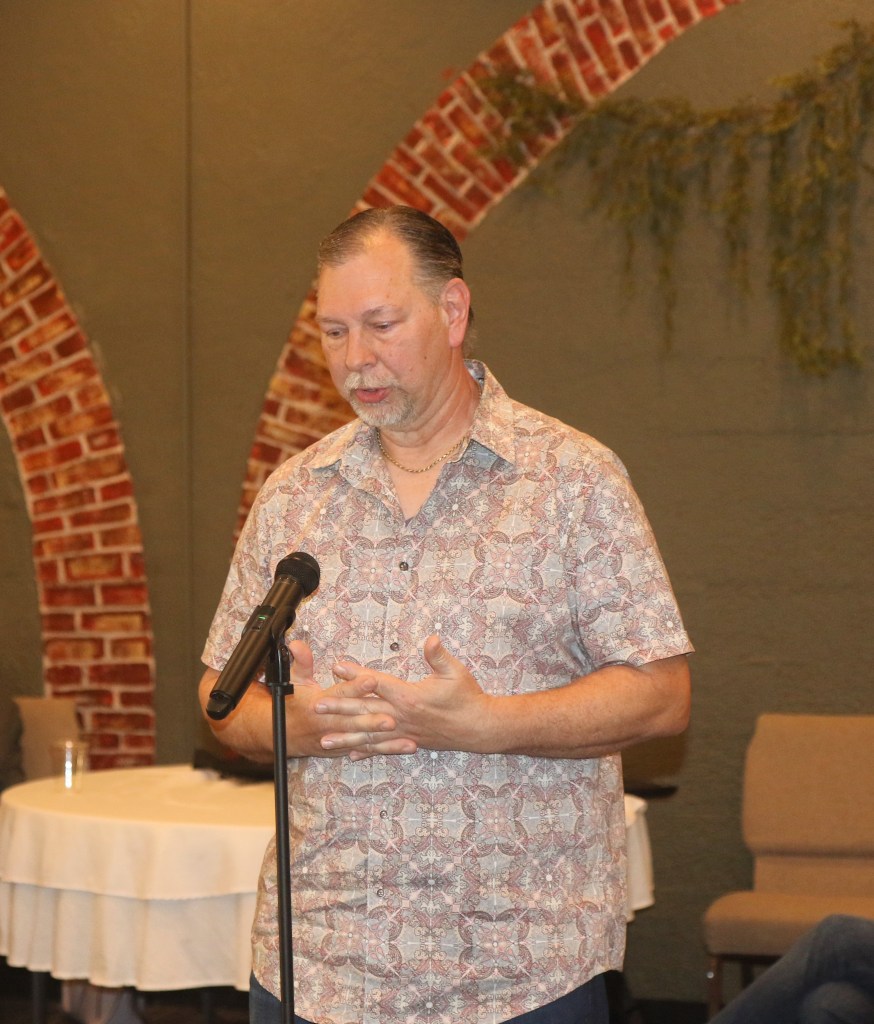
Photo: Scott Drummond who addressed Council at the meeting, was fine $100 for feeding stray cats
 Fulton County Ohio Media