
Swanton Village Council Withdraws Motion for Food Truck Legislation, For Now
On Monday night, at the final Swanton Village Council meeting of 2025, controversial Ordinance 2025-XX, Establishing Chapter 112 of the Codified Ordinances of the Village of Swanton, Ohio Regulating Food Trucks, Mobile Food Vending, Permitting, and Inspections, was on the agenda to be discussed as a Second Reading.
A few days prior to the meeting, Mayor Neil Toeppe posted on his Facebook page several important points that the Council would be taking into consideration before making a decision.
“It’s also worth noting that our brick-and-mortar food businesses pay significant property taxes. Those dollars help plow our roads, maintain our parks, fix potholes, and pay village employees. Many of these businesses also generously support local and school events through donations and sponsorships. Food trucks play an important role, too. They bring variety, introduce new offerings, and give residents and visitors options that may not otherwise be available locally. Their presence can also encourage established restaurants to innovate and improve. That’s a good thing. However, food trucks do not pay property taxes, which lowers their cost of entry into the market. While they benefit from village services, they are not contributing to them in the same way our permanent businesses do. So, the real question isn’t food trucks versus restaurants—it’s how do we continue to encourage food trucks while also finding a fair way for them to contribute to the village they operate in? That’s a conversation worth having,” he said.
The motion was first presented to Council President Derek Kania. “I would like to do a motion to push this into the new fiscal year. It’s not fair for the three outgoing (council members) to make a second reading call,” said Mr. Kania who will also be one of the outgoing members. He went on to explain what the Council’s intent was in considering the legislation and that oversight on food trucks operation in Swanton would be similar to what is practiced in towns like Delta, Holland and Perrysburg. “We’re not out here trying to make it difficult for everyone in the food truck world. Operating a food truck within the Village of Swanton doesn’t omit you from being inspected by certain entities, with or without an ordinance. It’s the Villages job to protect its citizens. We’re not trying to complicate matters. I, personally feel food trucks are a huge benefit to a town like Swanton. We do have some good restaurants, but we don’t have unique restaurants. Allowing a food truck to come in that offers a unique food style is a benefit. Once you start hammering fees on top of it, you lower the opportunity for that food truck to make it profitable to come out here.”
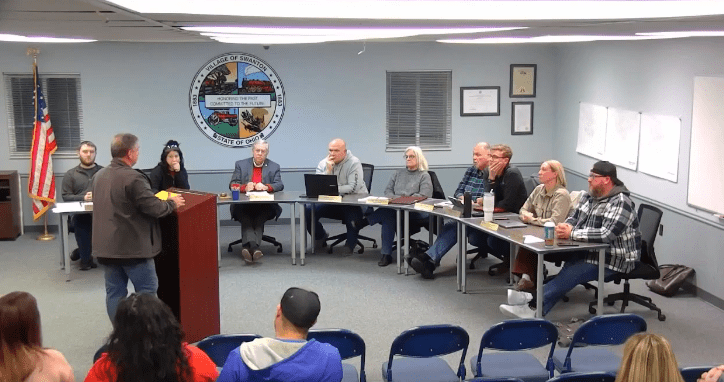
Following Mr. Kania’s remarks, a motion was put forward to withdraw the legislation. The motion was seconded and passed by a vote of 6-0. When the time came for public remarks, Dave Mills, owner of Birchwood Meadow Wedding and Event venue, cautioned the incoming Council to be sure to place Swanton in a positive light in which to do business. Swanton resident Tara Shaver, owner of the Hot Dogs 2 Go food truck spoke next and suggested if the Village decides to address this issue in the future, that they form a committee and look at the ordinance closely as it includes requirements food trucks already have to meet.
The next meeting will take place on January 12, 2026 at 6:00 pm in the Village Council room located at 219 Chestnut Street. All new Council members will be officially sworn in before proceeding with any Village business.
Photo: David Mills, owner of Birchwood Meadow, addresses Council regarding food truck legislation
 Fulton County Ohio Media